We can’t get enough of 40 percent keyboards and other adorably small — yet surprisingly effective — layouts
If you have any interest in mechanical keyboards, you already know the seemingly simple act of typing on a computer goes much deeper than some may assume. Your choice of switches, keycaps, lighting, and other concerns can have a big impact on the way you type. But the ocean of hobbyist keyboards isn’t just deep — it’s broad too, with sizes and shapes that range from roomy full-size keyboards to svelte 60% keyboards and beyond.
But what if you want to go smaller? Maybe desk space is at a premium, or you prefer an even more streamlined and minimalist typing experience. If so, a 40 percent keyboard may be exactly what you need. Here, we’ll explore what 40 percent keyboards are, how they compare to other sizes, and why a smaller keyboard may be the perfect fit for your typing style and overall workflow.
Find the perfect keyboard size for your desktop or on-the-go setup with our guide to everything from full-size to 20% boards.
What are 40 percent keyboards?
40 percent keyboards are much like 60 percent keyboards, in that they don’t have a numpad, arrow keys, the navigational cluster, or even function buttons. Now take this already quite honed-down form factor and lop off the number row, too — yep, the entire number row — and you have a 40 percent keyboard.
Unless you’re an immaculately accurate typist, you may have realized that the number row is also typically home to one of the most-used keys: backspace. 40 percent keyboards combine multiple functions onto a single key (that’s how they do numbers too), letting users swap between which functions are active by pressing a key: for instance, the common Planck layout surrounds its smaller space bar with keys to “raise” and “lower” the current layer, offering access to lesser-used keys such as the number keys on the higher layer and tilde on the lower. It’s a clever way to get a lot of use out of a very limited space.
Want to give a 40 percent keyboard a try for yourself? Here are two fan-favorite options.
Did You Know?:There are many ways to rethink the traditional keyboard. The HHKB layout repositions the Control key for a faster and more ergonomic typing experience.
Two of the best 40 percent keyboards
Planck EZ: The Planck EZ’s unique appearance is due in part to its ortholinear key layout. This means its keys are stacked up in linear columns rather than being staggered from row to row. Not only does this make for a unique typing experience, it also allows the Planck to pack more keys (such as dedicated arrow keys) into a smaller space. This unique take on keyboard minimalism doesn’t come cheap, with prices starting at $230.
Vortex Core: The Vortex Core has been around for a while, but it remains a favorite among 40% keyboard aficionados thanks to its solid and practical design with a thumb-friendly split spacebar. Unlike the Planck, it isn’t ortholinear, so the main thing your muscle memory will have to get used to is not having the number row — and having so much more space where all that extra keyboard used to be. You can pick one up for $89.
How 40 percent keyboards are different
40 percent keyboards sit squarely on the smaller end of the typing spectrum. But how do they stack up to the other available options? Here’s how 40 percent keyboards fit into the overall keyboard space.
- Full-size keyboards go as big as they possibly can. You get all the keys: a full function row, arrow keys, and even a numpad layout. They’re extremely popular for general office use, as they put every function most office workers need as its own dedicated key. However, they take up an enormous amount of desk space.
- Tenkeyless keyboards ditch the numpad while keeping the rest of the keys intact. These keyboards offer a sweet spot between size and functionality — keeping most of the features typists expect from a keyboard while removing redundant keys that are typically used in special circumstances.
- 60 percent keyboards go further, removing the arrow keys and condensing the rest into a smaller, space-saving form factor. This is where you start to see manufacturers include key combinations to replicate functions that have been removed.
- 30 percent keyboards are computer input devices that almost exclusively feature letter keys. They omit all the same elements as 40 percent keyboards and keep on cutting; no modifier keys like shift or control, and no spacebar. How do you write capital letters, or perhaps more importantly, anything that isn’t an unbroken string of characters? Much like with a 40 percent keyboard, the answer is that you get creative with the keys you do have by pressing multiple at once to generate different inputs.
- 20 percent keyboards are standalone numpads, typically speaking, and sometimes with additional macro keys built in for extra functionality. Why call them 20 percent keyboards? Well, another common name for tenkeyless keyboards is 80 percent boards — so the tenkey cluster they leave off makes up the remaining 20%.
Benefits of a 40 percent keyboard
40 percent keyboards offer many potential benefits to typists. Here are just a few:
- Smaller footprint: 40 percent keyboards pack a ton of functionality into a small frame, making them perfect for anyone with limited desk space.
- Comfort: The small footprint also reduces the space your hands need to move between the keyboard and mouse, improving ergonomics and overall comfort.
- Portability: The small size makes these keyboards easy to stow away in a bag, allowing anyone to bring a quality typing experience with them on the go.
- Programmability: Because 40 percent keyboards rely on special key combinations to expand functionality, many manufacturers offer customization options to let each user dial in the perfect typing experience.
- Style: These keyboards offer a compact minimalism that stands in stark contrast to even tenkeyless keyboards.
Did You Know?:The HHKB Snow Collection brings an elegant new look to the latest version of a fan-favorite keyboard — you can even opt for a pure white, legend-free aesthetic.
Who should use a 40 percent keyboard?
Small keyboards can be useful for those who know exactly what they want to do with their board. The following are just a few user profiles who might get something out of a 40 percent keyboard.
- Min/maxers: 40 percent keyboards take some time to get used to, but the unique layout and key combination system mean that typists can access just about anything they need without reaching. No wasted space, no wasted key presses — just pure efficiency.
- System administrators: If you need to bring a keyboard to work throughout the office, why bother lugging around a full-sized model when a 40 percent keyboard can do everything you need in a more compact frame?
- Hybrid workers without a dedicated workspace: If you work from home every now and then and only need a temporary workspace, a 40 percent keyboard can help you get your work done when you need it then virtually disappear when you don’t.
- Employees on the go: Type away at a coffee shop, on an airplane, in a hotel room, or anywhere else.
Maintenance and care tips for small keyboards
40 percent keyboards may be smaller than other types of keyboards, but the steps to keeping them clean and in working order are very similar.
- Keep your keyboard stored in a climate-controlled environment and out of sunlight to prevent damage to the plastic and other components.
- Clean your keyboard regularly. Remove the keycaps and use a brush or compressed air to remove dust, hair, and other particles from the board.
- Update your firmware regularly to ensure all of its features are operating efficiently.
Looking for a keyboard with a small footprint? Consider HHKB
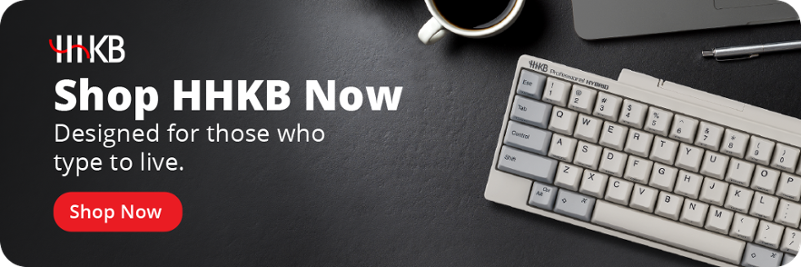
A small keyboard can offer a focused, ergonomic typing experience that larger keyboards simply can’t match — and HHKB Professional HYBRID keyboards are some of the best. Slightly larger than 40% keyboards, HHKBs still maintain a minimalist, portable form factor while offering more functionality and a more familiar layout. A compact size, a near-symmetrical layout, and high-quality Topre electrostatic capacitive switches offer a stellar combination of space-saving convenience, comfort, and versatility. You’ll even get a built-in Keymap Customization Function to personalize your keyboard workflows to your exact specifications.
Find your next keyboard today in our full range of high-end keyboards from HHKB.
Note: Information and external links are provided for your convenience and for educational purposes only. PFU America, Inc. makes no representations about the contents, features, or specifications on such third-party sites, software, and/or offerings (collectively “Third-Party Offerings”) and shall not be responsible for any loss or damage that may arise from your use of such Third-Party Offerings.