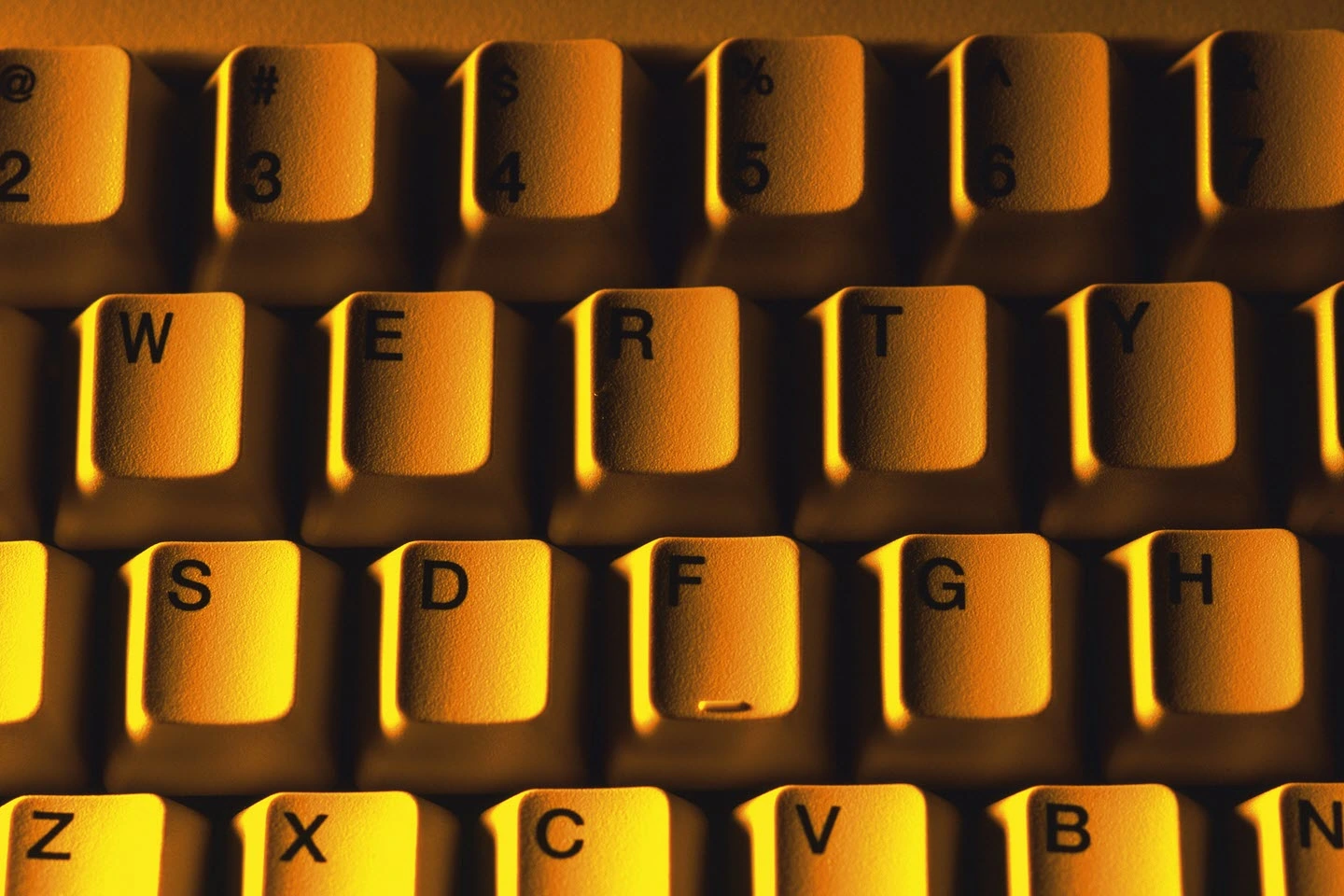
The first Happy Hacking Keyboard shipped in 1996 with a simple idea: carry only the keys a professional truly needs, arranged for the shortest reach. That first board was a 60 percent keyboard and we haven’t looked back since. If you have wondered whether a smaller board can still do everything a full-size one does, the short answer is yes, after a brief adjustment. You can see how that philosophy runs through the entire HHKB collection. Below, we cover what a 60 percent keyboard is, how many keys it has, what you trade away, and which of our models fits your setup.
Key Takeaways
- A 60 percent keyboard removes the function row, the arrow and navigation cluster, and the number pad, leaving about 60 to 68 keys.
- The removed keys move onto a Function (Fn) layer, so arrows and navigation still work through key combinations.
- The smaller footprint frees desk space for mouse movement and fits easily in a bag.
- Our HHKB layout goes further than a standard 60 percent board by moving Control to the Caps Lock position, keeping your hands on the home row for all your essential keyboard shortcuts.
Jump to a section:
- What Makes a Keyboard 60 Percent
- How HHKB Layout Differs From a Standard 60 Percent Board
- What You Give Up, and What You Get Back
- Where a 60 Percent Keyboard Earns Its Space
- Is a 60 Percent Keyboard Good for Programming and Writing
- Which HHKB Fits Your 60 Percent Setup
- Ready to Try a 60 Percent Layout
What Makes a Keyboard 60 Percent
The "60 percent" label comes from key count: the board carries roughly 60 percent of the keys on a full-size keyboard. A 60 percent board keeps the alphabet keys, the number row, the spacebar, both Shift keys, and the main modifiers like Ctrl, Alt, and Fn. It drops three sections: the function row across the top, the number pad on the right, and the dedicated navigation and arrow keys. We go deeper on the tradeoffs in our overview of 60 percent mechanical keyboards.
How Many Keys Does a 60 Percent Keyboard Have
Most 60 percent keyboards have 61 keys, with some designs ranging from 60 to 68 depending on how the bottom row is arranged. You reach arrows and navigation by holding Fn together with a mapped key. On many boards the arrows sit under a cluster like the I, J, K, and L keys, or under the WASD keys. If you want to change those mappings, keymapping software lets you assign functions to individual keys and Fn combinations. To see how 60 percent compares with other sizes, our keyboard sizes guide lays out the full range.
How HHKB Layout Differs From a Standard 60 Percent Board
Every 60 percent board, ours included, moves the function row and navigation keys onto the Fn layer. Our HHKB layout goes further than most 60 percent boards, with a handful of changes enthusiasts recognize on sight.
We place the Control key where Caps Lock normally sits, keeping your hands on the home row so a common shortcut no longer pulls a finger down to the bottom corner.
The Delete key sits a row lower than you'd expect, the tilde moves to the right side of the board instead of the left, and the bottom row uses its own unique key arrangement rather than the standard 60 percent layout. Taken together, these changes give the HHKB a silhouette experienced typists can identify at a glance.
The changes are small to learn. Most people adapt within a few days, and the reduced finger travel is the payoff.
We break down the full arrangement in our HHKB layout explainer.
What You Give Up, and What You Get Back
The real tradeoff of a 60 percent board is that the arrow keys and function row are no longer dedicated physical keys. They still work through the Fn layer, one combination away, and the shorter overall reach means less hand movement across a long session. The second tradeoff is the learning curve. Expect a few weeks of muscle memory adjustment before Fn combinations feel automatic. After that, most typists find the combinations faster than stretching to a far corner of a larger board.
Where a 60 Percent Keyboard Earns Its Space
A 60 percent board pays off most in setups where space and quiet matter. On a small desk or a cafe table, the reduced footprint leaves room to move a mouse freely, and in a bag the board takes up little room and travels without a case. A typical 60 percent board measures around 11 by 5 inches, well under the width of a full-size keyboard.
In a shared office or on an early call with a live mic, keystroke sound matters too. Our Professional HYBRID Type-S uses added buffer components built into the switch housing, a change from the prior generation aimed at a more subdued typing feel.
A compact board suits more than gamers: programmers and writers gain the same desk space and reduced reach. For grab-and-go builds, see our guide to portable mechanical keyboards.
Is a 60 Percent Keyboard Good for Programming and Writing
Yes, a 60 percent keyboard works well for programming and writing once you adjust to using the Fn layer for symbols and navigation. The only real constraint is relearning a few combinations; every function stays available. Dr. Eiiti Wada built the original HHKB layout around this priority, and our Professional line still follows a philosophy of designed by programmers, for programmers. Symbols, brackets, and modifiers stay close to the resting hand position, which suits both code and long-form writing.
Which HHKB Fits Your 60 Percent Setup
The right HHKB depends on how you connect, how quiet you need to be, and whether you want to swap your own switches. The table below maps common situations to the model we would reach for.
| Your Situation | What Matters Most | HHKB We Suggest |
|---|---|---|
| Shared office or calls with a live mic | A silenced bottom-out with wireless flexibility | Professional HYBRID Type-S (silenced Topre, 45g, Bluetooth up to 4 devices) /td> |
| Locked-down workplace where Bluetooth peripherals are not allowed | A wired-only connection | Professional Classic (USB-C wired) |
| Moving between a laptop, a tablet, and a desktop | Fast multi-device switching | Professional HYBRID (Bluetooth up to 4 devices) |
| Creating and wanting to change switches or add pointing controls | Hot-swap sockets and on-board controls | Studio (HHKB Studio Original Kailh Linear, Cherry MX compatible, hot-swappable, with Gesture Pads, Bluetooth up to 4 devices) |
| No room/desire for using a separate mouse | An all-in-one keyboard device | Studio (integrated mouse functionality, customizable Gesture Pads, HHKB Studio Original Kailh Linear, Cherry MX compatible, hot-swappable, Bluetooth up to 4 devices) |
If you are unsure, the Professional HYBRID Type-S is our most broadly useful pick: quiet enough for shared spaces and flexible enough to pair with up to four devices wirelessly while also offering secure wired connection.
A Topre board does cost more than a mainstream 60 percent keyboard, and the reason is the switch and the build. Our Professional series uses an electrostatic capacitive switch, meaning it registers each keypress through a change in an electric field rather than metal parts touching.
Because there's no metal contact to bounce, the switches never develop key chatter — the repeated, unintended inputs that plague worn switches over time. Each switch is rated for up to 50 million keypresses, which is why many owners keep the same board running across several computers over the years.
Ready to Try a 60 Percent Layout
The clearest next step is to start with the model that fits the widest range of situations. For most people moving from a full-size board, we suggest the Professional HYBRID Type-S, which pairs a silenced Topre switch with Bluetooth for up to four devices.