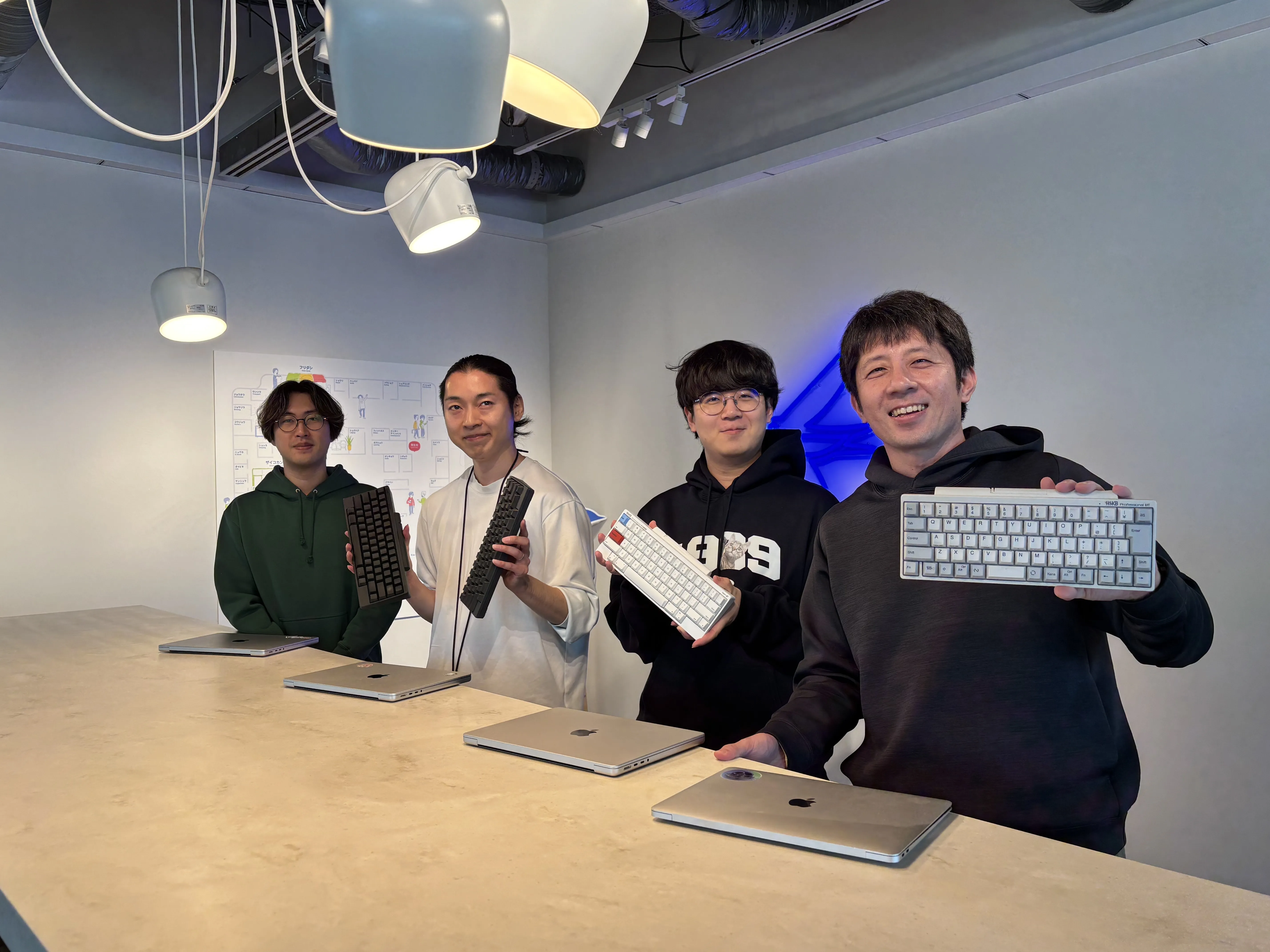
With their promising future, engineering and programming are rapidly growing professions. Given that they likely spend more time typing than other desk workers, haven't you ever wondered what kind of keyboards they use?
Let’s have a chat1 with some of the engineers working at freee K.K. Co., Ltd., to learn more about their company and how HHKB fits in.
What kind of company is freee K.K. Co., Ltd..
freee K.K. Co., Ltd. is known as a pioneer in cloud accounting software, and is currently developing an "integrated cloud ERP," an "open platform," and a "user network" to create an integrated management platform that allows anyone to run their business freely.
After going public on the Tokyo Stock Exchange Mothers Market (now the Tokyo Stock Exchange Growth Market) in December 2019, the company is recognized as one that will continue to grow in the future. Now in its 13th year since its founding in 2012, people of various ages work together in a collaborative environment. The company is filled with a culture of "real value" (doing what you can confidently say has intrinsic value to users) and "a spirit of challenge without fear of failure" (taking immediate action on ideas, quickly learning from failures, and moving forward).
What are the favorite gadgets and work environment of engineers working at freee K.K. Co., Ltd.?
freee K.K. Co., Ltd., now a publicly listed company, has more than 1,700 full-time employees, and its development department has expanded year by year to become a large-scale organization. We asked engineers of various ages and backgrounds about their favorite gadgets, work environment, and thoughts on their work.
Mr. Asaba
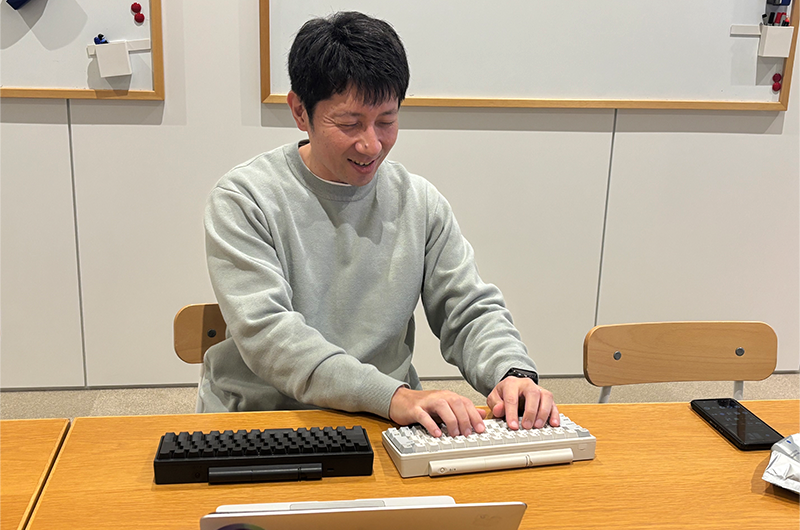
Yoshiyuki Asaba, a.k.a. Asaba
HHKB: First of all, please introduce yourself!
Asaba: I joined freee K.K. Co., Ltd. in 2015, so I have been with the company for about 10 years. Immediately after joining the company, I was mainly in charge of infrastructure development, then I became the general manager of the Product Infrastructure Development Division, and two years ago I was stationed in the Philippines as a director of a Philippine group company, and I returned home last week.
HHKB: Could you tell us about your usual work style (e.g., the balance between on-site and remote work) and your company's support systems?
Asaba: Engineers are encouraged to come to work two to three days a week, and I come to work three times a week. I keep an HHKB at the office and at home, respectively, because carrying a keyboard is a hassle. When I was stationed in the Philippines, I brought one there as well. I have a MacBook Pro and go back and forth between home and the office.
HHKB: What kind of keyboard model and layout do you use?
Asaba: I use the HHKB Professional HYBRID Type-S Charcoal model at home and the HHKB Professional HYBRID White model at the office. Both models have Japanese keyboard layout. Many engineers and programmers seem to prefer English keyboard layouts. For me, though, I often visit data centers where I’m unable to bring my own keyboard. Using a different layout there might cause typing errors, so I stick with a Japanese layout. As an infrastructure engineer, too much customization of the keyboard may cause problems in the production environment, so I try to use a keyboard with as little customization as possible.
HHKB: How did you come to know about HHKB and why did you purchase it?
Asaba: When I was in graduate school, I was allowed to use an HHKB that was in my laboratory. It was comfortable to type on and helped me get more done, so I thought, "This is it!” It was too expensive for me to buy when I was a student, so I bought it after entering the workforce.
HHKB: What were your impressions of the HHKB when you actually used it?
Asaba: You might think that the lack of independent function keys and the need to use the combination keys while pressing the Fn key would make it difficult to use, but in my case, I didn't think so. Because I used to use a UNIX-like OS called Solaris, and since Solaris is not rich in functions like Windows, just the basic keys are fine. So I didn't have any trouble with a small number of keys. Occasionally, I use the genuine Mac Magic Keyboard. I find that one to be very comfortable to type on, but in the case of the HHKB, the smooth, satisfying sound of the keys is also nice.
HHKB: What are some of the things you are particular about or keep in mind in your work?
Asaba: I prefer a wide display screen, such as a 4K display. Recently, however, I try to work while standing for my health. I am beginning to be interested in standing desks, such as height adjustable desks. Speaking of health, I’d immediately want an HHKB model with a split keyboard design if it’s released.
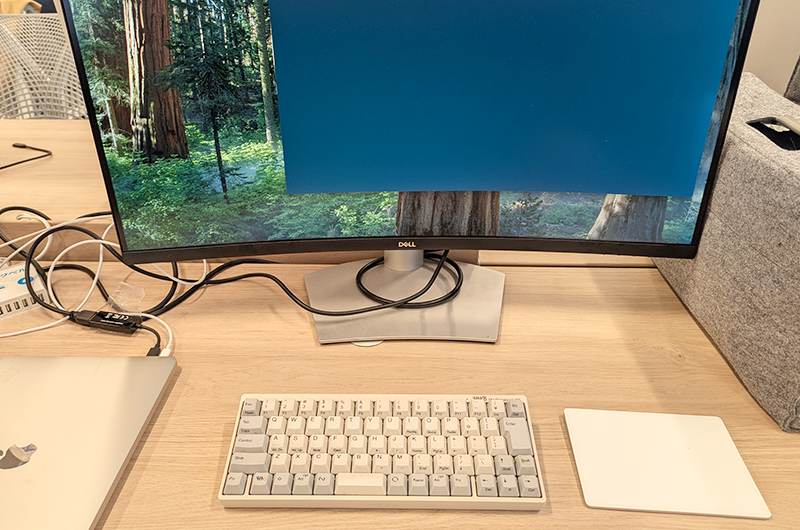
Asaba's work environment. It's clean and clear.
While generative AI is currently in the spotlight, I feel that the power of software created by humans thinking and typing at their keyboards is truly remarkable. The fact that software will continue to be created by people is unlikely to change. That makes the choice of interface very important. I have great respect for type-driven development in Japan, including the Happy Hacking Keyboards that support freee’s products.
Mr. Keik
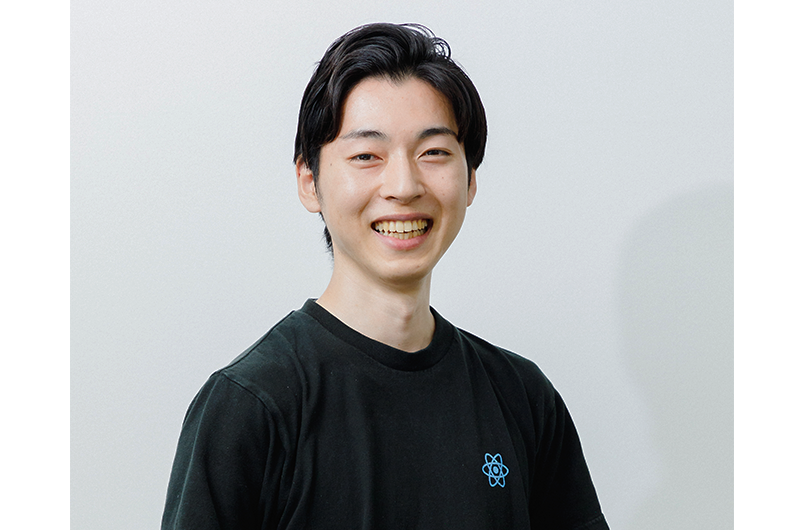
Kei Kato, a.k.a. Keik
HHKB: Please tell us about your work and your role in the company.
Keik: My name is Kei Kato. In the company, I am called "Keik" (kaykay). I joined freee K.K. Co., Ltd. about 8 years ago in January 2017, and I am involved in the product development of freee HR. Within my team, I serve as product CTO, or technical director for the product I’m in charge of.
HHKB: Please tell us about your daily work style and your company's support system.
Keik: The minimum requirement for engineers is to come to work three times a week, but I come to work almost every day. Meetings take up about half of my day.
HHKB: What kind of keyboard model and layout do you use?
Keik: At home I use a HHKB Professional2 blank Charcoal model with English layout, and in the office I use a HHKB Professional HYBRID Type-S blank Charcoal model with English layout. The one for the office has Bluetooth connectivity, but I use it wired. This is because I feel that with Bluetooth, the latency sometimes changes. For example, when I type "K" (on the right side of the keyboard) and "A" (on the left side of the keyboard), the "ka" is not displayed, but "ak" is. I use it with a wired connection because I value stability.
HHKB: How did you come to know about HHKB and what was your motivation for purchasing it?
Keik: When I was a student, I was interested in HHKB because I saw one of my seniors in my lab using it. He was using a HHKB Professional2 Charcoal model, and at first glance it looked like there was nothing engraved on the key tops, which surprised me because I was not familiar with the world of keyboards at the time.
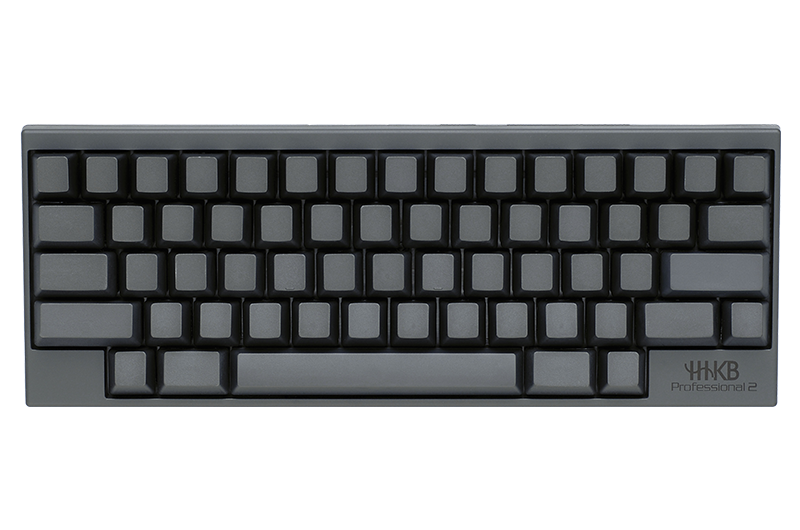
HHKB Professional2 English model Charcoal (blank)
However, when I heard my senior typing from afar, the typing sound was pleasant and satisfying, and I began to pay attention to it. That senior gave me HHKB Lite and that's when I started using HHKB, then I liked it so much I bought one myself.
If I didn't have it and used only the keyboard on my MacBook, I'd probably lose half of my productivity.- Kei
HHKB: What are your impressions of HHKB?
Keik: I like the sound of the keys and the feel of the keys. For me, HHKB is a tool that I am comfortable with, that I feel “this is the only one” and “this is just how it should be.” If I didn't have it and used only the keyboard on my MacBook, I'd probably lose half of my productivity. I often get asked why I use two keyboards, and it actually started when my wife told me, “Your neck is leaning forward.” To protect my shoulders and neck, it’s better to work with your shoulders open, so I set up and use two keyboards side by side. I hadn’t noticed any issues with my body before, but thanks to using two keyboards, I don’t experience any pain and can work with good posture. It cost about 60,000 yen for the two, but if it helps prevent problems, I think it was a worthwhile investment.
HHKB: Please tell us what you are particular about and what you keep in mind when you work.
Keik: Some engineers get into self-made keyboards when they start to get stiff. Some may think, "If I want to open up my shoulders, why don't I just make my own split keyboard?” But it seems difficult to achieve the keyboard feel of the HHKB with a home-made keyboard, and for me, a keyboard is a means, not an end. So I am satisfied with this finished product.
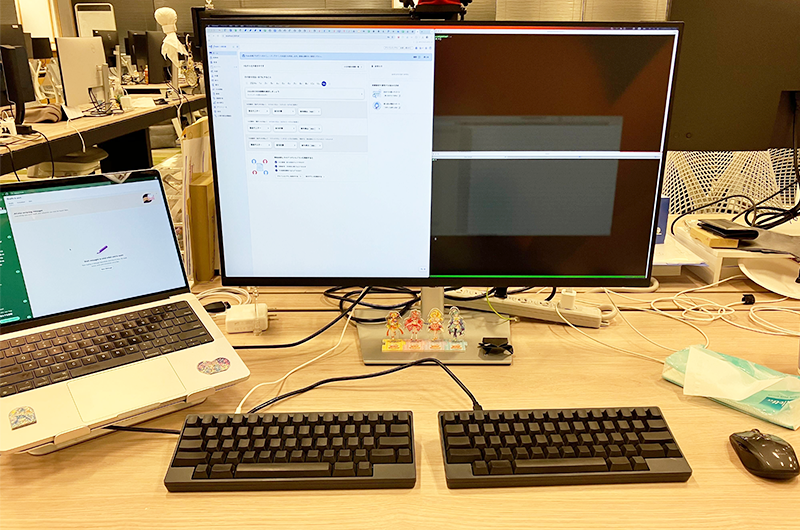
Keik's work environment. 2 HHKB Professional2 Charcoal models are used at the same time. He says this helps to open up his shoulders and reduce the strain on his body when working for long periods of time.
I believe that the keyboard interface supports the people who create the products at freee. I am very grateful for the tools that support freee’s products.
Mr. Jason
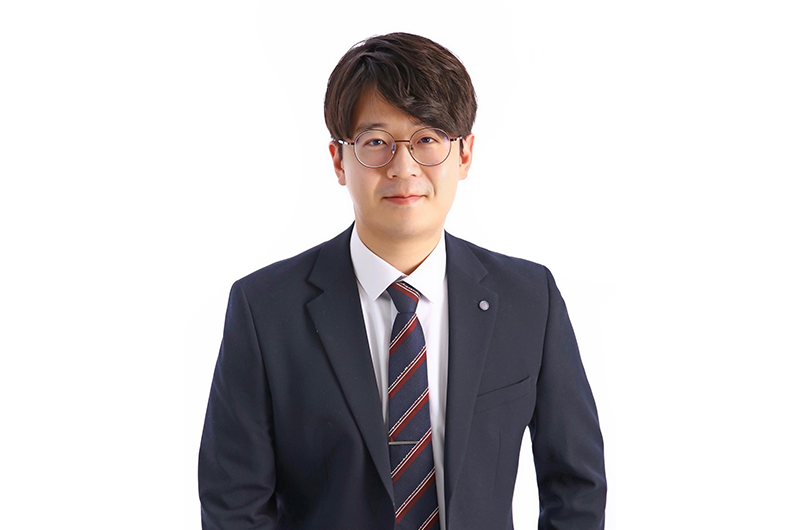
Mr. John Jesson, aka Jason.
HHKB: Please tell us your name, what you do, and what your role is.
Jason: My name is John Jesson. Internally, I go by the nickname "Jason”. I am an engineer from Korea who is in charge of the accounting and credit management area and billing development. My development environment is macOS, and sometimes I use Linux.
HHKB: Please tell us about your working style (e.g., the ratio of coming to work and telework) and your company's support system.
Jason: I usually come to the office once a week, but sometimes I come to the office four times a week if necessary. For example, if I think it would be faster if we all get together to talk. I moved near the company a short time after I joined because I felt that the company culture values offline communication.
HHKB: What is the model and layout of the keyboard you are using?
Jason: In terms of HHKB-related products, I have three keyboards: a HHKB Professional HYBRID Type-S Snow model, a HHKB Studio Snow model, and a tofu60 2.0 keyboard with a custom HHKB layout, along with a Keyball61, a LEOPOLD FC 660C, and a logicool MX KEYS mini. All are English layout.
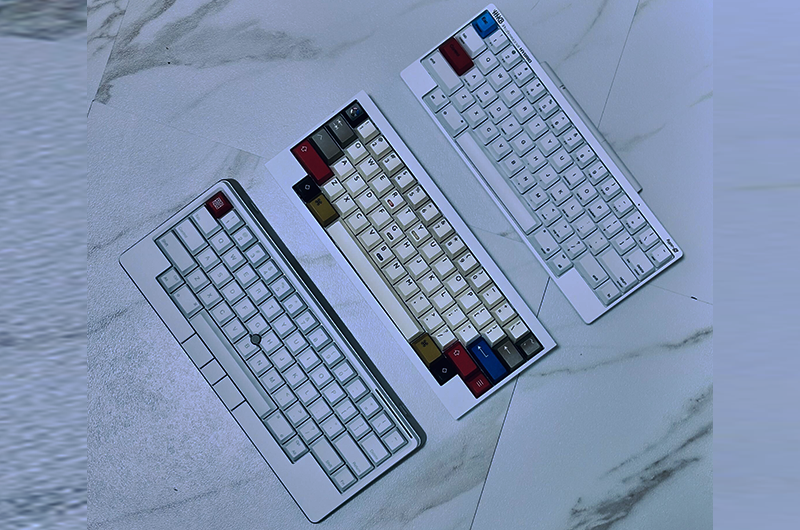
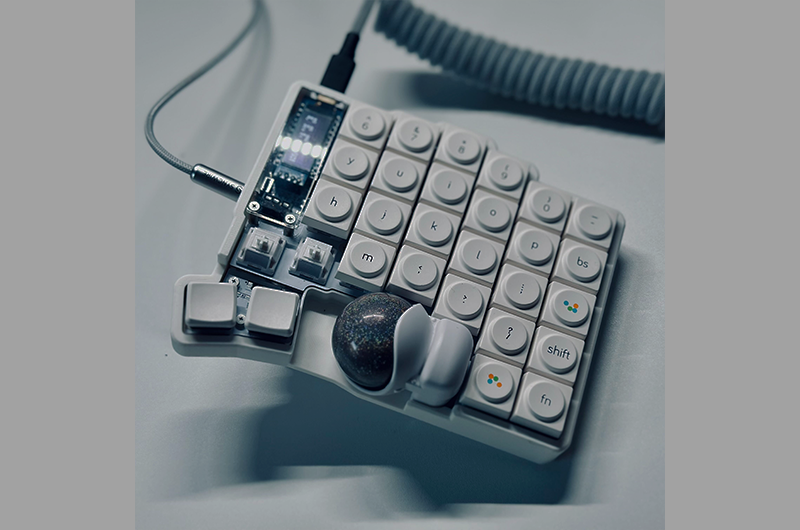
This is the Keyball61, a separate keyboard of his own design.
You might think, “Engineers don’t type in Japanese much, so they use a US layout,” but in reality, we actually type in Japanese quite a bit. Since a lot of communication happens over Slack, about half of the text I type is in Japanese. In fact, I spend only around two hours a day writing code.
HHKB: How did you come to know about HHKB and what motivated you to purchase it?
Jason: A friend of mine from college was using HHKB. When I heard the price, I thought it was expensive, but I was attracted by its simplicity and the fact that it seemed easy to carry around. I thought I would buy one when I started earning a salary, but I was actually a little worried. I like white things, but the white model of HHKB at that time was a little grayish white, not pure white. While I was wondering what to do, a pure white design (Snow model) came out, and I thought, "I must buy it.”
The HHKB strikes just the right balance. I think it's great that it's optimized so that you can operate the mouse (cursor operation) with just the keyboard, with minimal finger movement from the home position. -Jason
HHKB: What are your thoughts on the actual use of the HHKB?
Jason: Actually, I have three other keyboards in my office, but I feel that HHKB is easier to use. This is because the size is just right. Compact size keyboards allow me to have more space on my deck, which makes it easier to customize my work environment. However, if it is too small, it is hard to type on. The HHKB strikes just the right balance. I think it's great that it's optimized so that you can operate the mouse (cursor operation) with just the keyboard, with minimal finger movement from the home position.
HHKB: Please tell us what you are particular about and what you keep in mind when working with HHKB.
Jason: I change the six keyboards I have on a weekly basis. In some cases, I change them every day. They are all US layout, so there is no confusion. When it comes to my work environment, I sometimes get pain in my right shoulder, right hand, and neck, so I place the trackball on the left side of my body as well and use it with both hands. This reduces the burden on the right side of my body.
HHKB: What devices or gadgets do you recommend, and what are you interested in at the moment?
Jason: A friend of mine from college was using HHKB. When I heard the price, I thought it was expensive, but I was attracted by its simplicity and the fact that it seemed easy to carry around. I thought I would buy one when I started earning a salary, but I was actually a little worried. I like white things, but the white model of HHKB at that time was a little grayish white, not pure white. While I was wondering what to do, a pure white design (Snow model) came out, and I thought, "I must buy it.”
Jason: I like Apple products, and among them, I like the iPad mini and Apple Pencil combination; I find it easier to carry than the 13-inch iPad Pro and more convenient to take notes anywhere. I also love the Type Stix which allows me to use the HHKB on top of my Mac keyboard.
Additionally, I enjoy personal development projects and posting on Instagram as hobbies.
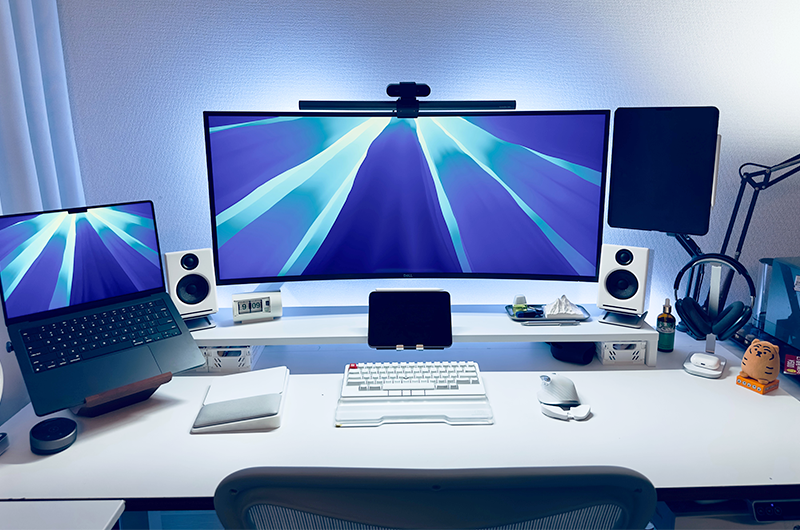
Jason’s work environment. It has a futuristic atmosphere.
freee K.K. Co., Ltd. uses different programming languages for different products. We have an environment where it is easy to take on new challenges, with assistance for learning new languages and skills if necessary for the job. There are many people who, like me, love keyboards, and the company even has a “Keyboard Club.” Recently, the keyboard channel on Slack was buzzing with excitement about HHKBs being available through the hometown tax program. I also feel that the company values offline, in-person conversations.
Mr. Nik
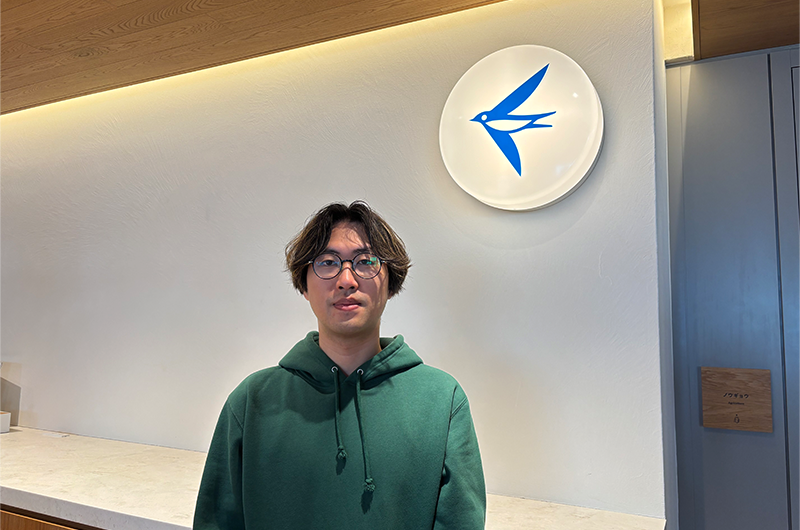
Mr. Kin Shun, aka Nik
HHKB: Please tell us your name, your business, and your role in the company.
Nik: My name is Kin Shun. My nickname is "nik" (nick). I am an engineer from China who is in charge of functional design, development, and operation of "freee card Unlimited," a corporate card for business clients, in the Spending Development Team, Transaction Development Division.
HHKB: Please tell us about your usual working style and your company's support system.
Nik: Basically, I come to work once a week for an offline meeting. At the meeting, we share the plan for the week and the results of the previous week. Other than that, I basically work remotely.
HHKB: What kind of keyboard model and layout do you use?
Nik: I use the “NocFree Lite” keyboard, which is separated into left and right keys, the “Keyball61” keyboard, which is also separated into left and right keys and has a trackball, the “Rainy75” keyboard, which has keystrokes that sound like raindrops, and the “QK60” keyboard from the QK series, which has a heavy feel.
All of them are mechanical keyboards, which are different from HHKB. For the left and right detachable type, I customize them by replacing the keyswitches and keycaps with my favorite ones. All of them have an English layout.
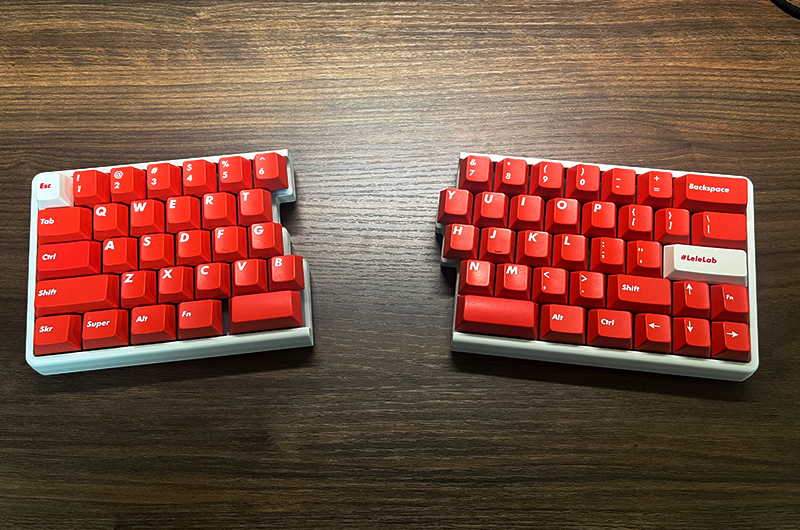
Nik's favorite NocFree Lite wireless split keyboard
HHKB: Have you had any experience with HHKB?
Nik: Yes, I have. I like the touch feeling of the capacitive no-contact system. I thought, "No other keyboard can compete with this.” It's also comfortable to touch, and it's very quiet, so I felt that it could be used quietly in an office. I'm thinking of buying one someday, but I'm too scared to do so. Because I like keyboards and want to enjoy different variations. But I think HHKB is the right keyboard for me because of its high reputation.
In other words, if I start using HHKB, my journey in pursuit of keyboard variations will end - I am still unable to buy one because of this fear. (From the editor: You could continue your journey with HHKB as your home port!)
HHKB: Is there anything you are particular about or keep in mind when you are working?
Nik: I only come to the office once a week, and I would prefer to work at home if I could because I have a better working environment at home, but I feel that there are tremendous communication benefits to coming to the office.
For example, I can have a normal conversation, and what I might need to exchange several times to get my point across in a chat room, I can finish in a few seconds if I am offline.
In terms of my work environment at home, I recently changed from a wide monitor to a 34-inchone. The reason why I didn't go with a larger size is because, like Jason, I felt it would be difficult for the other person to see when I shared the screen with them. However, recently, more and more people are using wide monitors, so I have come full circle and think, "That would have been fine, too.
HHKB: What devices or gadgets do you recommend or are particular about, and what are you interested in at the moment?
Nik: It may not be a gadget, but I love vacuum mugs. They have high heat-retention performance, so it keeps my tea warm for one to two hours after pouring it. This is good because I like to work with a hot drink during the current season. Then there are the good office chairs. I use a Herman Miller Aeron chair.
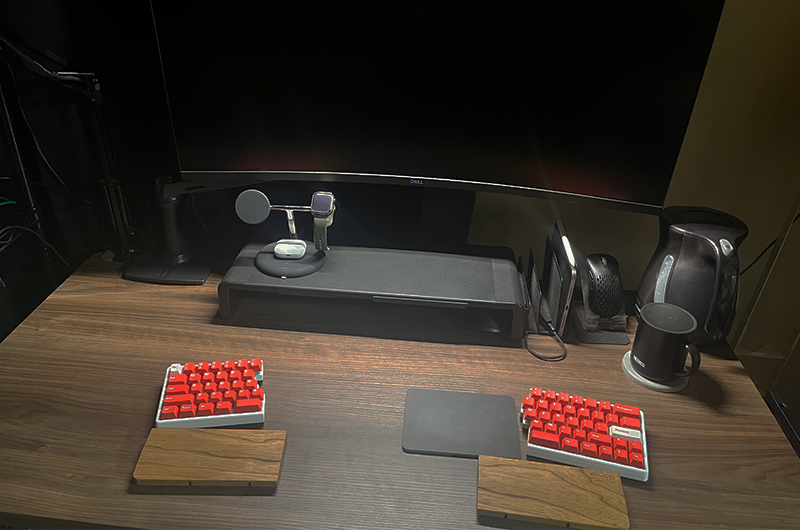
Nik's work environment. On the right side is his favorite vacuum mug.
1 Based on information as of February 6, 2025
Author
Marika Watanabe
A freelance writer with a deep love for gadgets that run on electricity. She has many hobbies: she enjoys horses and holds a riding license, loves the sea and has a Class 2 small boat operator license, and fulfilled a long-time dream by obtaining an ordinary motorcycle license. While curbing her material desires, she also pursues analog interests, with knitting serving as a lifelong passion.